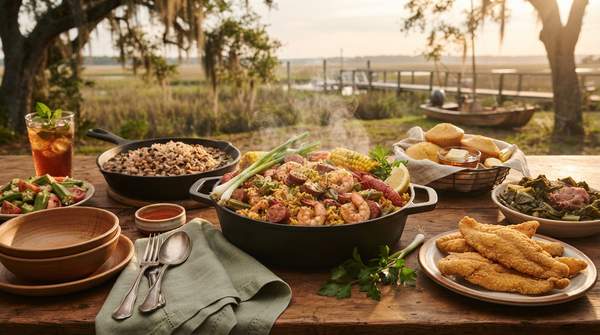
Lowcountry cuisine is a creolized foodway: a genuinely new cooking tradition born when West African, European, and Native American foodways converged on the coastal plains of South Carolina and Georgia. Culinary historians use that term deliberately. The food of the region is not a simple sum of borrowed dishes but a synthesis, in which African rice and one-pot stews, European livestock and refined cooking styles, and indigenous American ingredients were adapted to one another and to a landscape of tidal rivers, marshes, and rice fields. Understanding which strand of that braid contributed what is the key to understanding why a bowl of Hoppin' John or a shrimp stew tastes the way it does.
The Lowcountry: A Culinary Crossroads
The Lowcountry is the low-lying coastal region of South Carolina, extending along the Georgia coast, and its geography did more than set a backdrop—it determined what was on the table. As South Carolina ETV's educational project on the region's foodways explains, these food traditions "have been shaped by the natural and economic resources of the area." Tidal creeks and estuaries supplied fresh fish and shellfish; the wet, low-lying land proved suited to rice cultivation once the right agricultural knowledge arrived.
That knowledge came under brutal conditions. West Africans were forcibly brought to the Carolinas, Georgia, and Florida in the 18th century to work rice, cotton, indigo, and tobacco fields, as the Gullah Geechee cultural record preserved by the Cooking & Culture Project describes. The Gullah community, shaped by a long agrarian life and relative insulation from outside urban influence, retained more of its African ways than many other African American communities—and that retention is precisely what makes Lowcountry food distinct from Southern cooking generally.
The region was also a meeting point of many peoples, not just three. A South Carolina culinary history published through the University of South Carolina's scholarly commons describes culture groups from across Africa, Europe, the Americas, and Asia converging in the state, "often at odds," and producing an ongoing culinary dialogue. Within that crowded field, three traditions did the foundational work.
West African Roots: Rice, Stews, and Sustenance
The African contribution is the load-bearing wall of the cuisine. As ABC News reported in a profile of a Charleston chef honoring his Gullah Geechee roots, Lowcountry cuisine carries "ingredients that made it to the states from Africa during the slave trade and techniques that created a unique culinary footprint in the Southeast." Rice, okra, cowpeas, peanuts, melons, hot peppers, and leafy greens all traveled that route, alongside the knowledge of how to grow and cook them.
The chef's framing, quoted by ABC News, puts the connection plainly: "Along with the food of south Louisiana, Lowcountry cuisine is perhaps the most direct connection we have to the food cultures of West and Central Africa. The rice, tomatoes, peanuts, cowpeas, okra, leafy greens, melons, hot peppers and fresh fish and shellfish are signature on both sides of the Atlantic."
Rice deserves special emphasis. Enslaved West Africans brought deep expertise in rice cultivation, and that expertise—extracted through forced labor—built the plantation economy that made Charleston wealthy. The same grain became the daily staple of the cuisine itself. Alongside rice came the one-pot cooking method: hearty stews that combined a grain, a legume, greens, and whatever protein was available into a single sustaining dish. This technique, not any single recipe, is the African structural signature of the foodway.