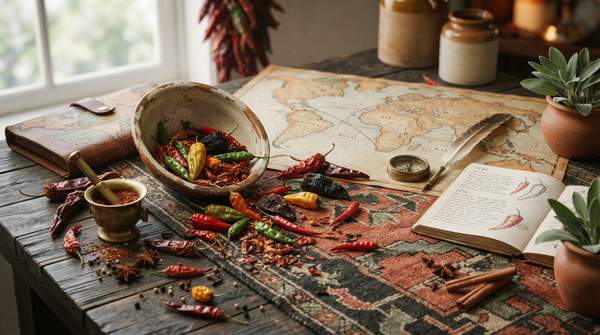
In barely a century, the chili pepper went from a wild fruit in South America to a kitchen staple on five continents. Its journey began with birds, accelerated dramatically after Christopher Columbus carried the plant across the Atlantic in 1493, and was completed by Portuguese and Spanish traders who moved it through Africa, Arabia, India, China, and the Philippines within a single lifetime. Understanding that sequence of dates and routes transforms how you see every spicy dish on the table.
The Humble Origins of a Global Spice
Every chili pepper in the world today traces its ancestry to the Americas. According to the Chile Pepper Institute at New Mexico State University, chile peppers originated in the lowlands of Brazil as small red, round, "berry-like" fruits, in a region botanists call the "nuclear area" because it holds the greatest number of wild chile species in the world. Other accounts place the earliest origins in Mexico, Bolivia, Peru, and elsewhere in Central and South America, with the exact birthplace still debated. What is not debated is the ending of the story: as the editors of the volume Chilies to Chocolate note, the pepper dispersed "so swiftly and thoroughly" that botanists long mistook it for a native of India or Indochina, though all scholars now agree it is a New World plant.
Natural Beginnings: Pre-Columbian Dispersal
Long before any ship carried a chili, birds were the plant's first couriers. Scientists believe birds are mainly responsible for spreading wild chile peppers out of their Brazilian nuclear area, and the relationship is a genuinely symbiotic one. Birds lack the receptors that feel chili heat, and a bird's digestive system does not harm the seed, so the fruit passes through intact and viable. Birds are drawn to the fruit's sweetness, eating chilies freely where mammals would be deterred. Over centuries, this natural partnership carried the plant across the Americas well before human cultivation or trade entered the picture. The pepper's later global success owes something to this early training: it was already equipped, through dry seeds that remain viable for long periods, for long-distance transport.
The Columbian Exchange: A New World to the Old
The pivotal moment came in 1493, when Columbus brought the "ají" — the chili pepper he encountered in the New World — back to Spain on his second voyage. It is one of history's small ironies that Columbus was searching for black pepper when he found this one instead, and the name stuck anyway. From Spain, the plant moved quickly: west into Portugal, north as far as Britain, and east through the Mediterranean, as a map of the dispersal produced by Cornell Botanic Gardens traces. Within a few decades, the chili had established footholds across Western Europe, reaching Eastern and Central Europe by the mid-1500s. But Spain's role, while foundational, was only the opening act. The pepper's true global explosion was driven by other empires' ships.