The American Sunday dinner is not one tradition but several, and the two most storied versions grew from opposite historical experiences. The Southern and African American Sunday dinner took shape under slavery, when Saturday-evening provision distributions made Sunday's meal the week's largest, and it matured after emancipation around Black churches as a gathering place safe from segregation. The Italian-American Sunday supper arrived with late nineteenth- and early twentieth-century immigrants who worked six-day weeks as laborers, and it became their one day of social connection and a way to display hard-won success in a new country.
Introduction: The Enduring American Sunday Dinner
Before air conditioning, two-income households and youth sports schedules fragmented the calendar, Sunday afternoon was the one moment many American families could reliably gather. Writing in Tasting Table, Karen Greco traces the broader custom to an agrarian mid-afternoon meal tradition, noting that Sunday dinner endured in a post-urbanized society because it was the only day on which many families could actually sit down together, a point she attributes to Smithsonian Magazine.
But the shared weekly rhythm conceals very different origins. In the Black community, the tradition is rooted in slavery, as the writer Nneka M. Okona explained in Zora. In Italian American homes, it grew from an imported family ritual adapted to industrial labor. Understanding those distinct beginnings is what turns a nostalgic plate of fried chicken or a platter of spaghetti and meatballs into a readable piece of American history.
Southern/African American Sunday Dinner: A Legacy of Resilience and Community
The mechanics of the tradition began with the plantation ration system. In "Soul Food as Cultural Creation," essayist William C. Whit explains that "Saturday night was usually the time for distributing slave provisions." Because enslaved people received their weekly allotment on Saturday evening, Sunday's meal could be larger than normal — a practice that, as PushBlack's Briona Lamback recounts, "has continued with minor modification in many African American households."
Sunday was also the one day of rest, and the meal carried an emotional weight beyond food. Okona writes that "Sunday arose as that sole day of the week where [slaves] could pretend they were free." After emancipation, the dinner evolved rather than disappeared. As freed people built lives outside captivity, the meal became the moment to drop one's shoulders after a week of labor — laughing, playing cards or dominoes, dancing, and sharing the stories that kept communities bonded.
Churches then gave the tradition an institutional home. According to the Chicago Tribune, as Greco reports, post-emancipation Black parishes in the South hosted the post-worship meal, which kept people at service and strengthened community by offering a place where families could eat together without worrying about segregation. PushBlack describes church basements filling after service, long dining tables holding communal feasts, with soul foods like sweet potato pie and fried chicken brought by church members to the shared table.
Italian-American Sunday Supper: A Symbol of Family and New World Success
The Italian-American version carried different luggage. Immigrants from Italy arrived with the custom of a long Sunday family meal, and in the United States they adapted it to the realities of industrial work. As Greco's reporting explains, most Italian immigrants worked six days a week as laborers, so Sunday was the only day of the week to socialize. The big midday meal became the anchor of that single free day, reinforcing family bonds while lives were otherwise consumed by work.
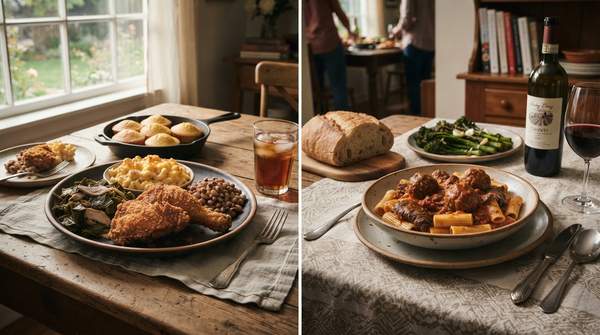
The meal also did quiet social work. Greco notes that the Sunday table sometimes served a dual purpose for immigrants eager to show off status, with a spread "groaning under the weight of food" like spaghetti and meatballs and eggplant parmesan acting as a silent brag about American success. Where the Southern tradition expressed survival and freedom within a hostile society, the Italian-American supper expressed arrival: proof, dish by dish, that the family was making it in the new country.
Comparative Overview: Southern/African American vs. Italian-American Sunday Dinner
Placing the two traditions side by side shows how similar weekly rituals can encode entirely different histories. One emerged from the constraints of enslavement and grew into post-emancipation community building; the other traveled from European family custom through the immigrant experience of six-day labor and the desire to establish social standing in a new land.
| Dimension | Southern/African American Sunday Dinner | Italian-American Sunday Supper |
|---|---|---|
| Historical Origin | Rooted in slavery: provisions were distributed to enslaved people on Saturday evening, making Sunday's meal larger than normal; the practice continued and evolved after emancipation. | Brought by Italian immigrants, where the long Sunday family meal was already custom, and adapted in the U.S. by laborers who worked six days a week. |
| Primary Social Function | A weekly respite — the day enslaved people could, in Okona's words, "pretend they were free" — that later fostered community building and offered respite from segregation. | The only day of the week for socialization, reinforcing family bonds and serving as a display of new-found status and success in America. |
| Typical Setting | Post-emancipation, centered on Black church communities in the South, with meals in church basements and homes — a safe space for gathering. | The family home, with a table laden as a "silent brag" about American success. |
| Representative Dishes | A larger-than-normal Sunday meal; post-worship church meals included soul foods like sweet potato pie and fried chicken brought by members. | Spaghetti and meatballs and eggplant parmesan among abundant spreads. |
The comparison makes the central distinction visible. The Southern tradition's setting — the church basement — reflects a community that needed a space it controlled, while the Italian-American home table reflects a family asserting itself in a society it was newly entering. The dishes tell the same story: communal, carried contributions on one side; abundant, status-signaling abundance on the other.
Understanding the Enduring Legacy of Sunday Dinners
The reader's takeaway is to recognize that the "American Sunday dinner" is not a monolithic tradition but a collection of distinct cultural practices, each deeply embedded in the unique historical experiences of different communities. One carries the memory of Saturday rations and a single day of imagined freedom, then the church basement feasts that held a people together through segregation. The other carries the memory of six-day labor and a table that proved, quietly and deliciously, that an immigrant family had arrived.
The measurable indicator of that legacy is the continued practice of these distinct Sunday meal traditions within their respective communities, reflecting their enduring cultural significance. Whether the marker is a church basement dinner after Sunday service or a Sunday gravy simmering for a multi-generational family table, the traditions persist — and their persistence is itself the evidence that these histories still matter at the American table.