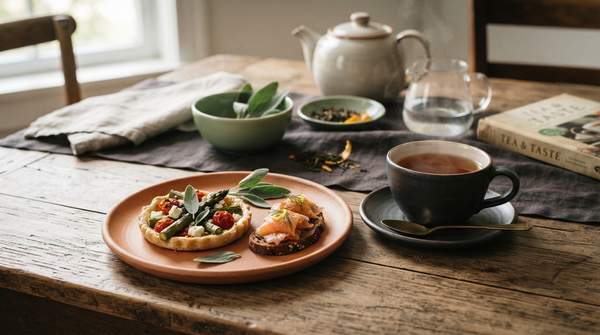
Pairing tea with food comes down to two moves. You either echo a flavor the dish already has—what tea sellers describe as matching, or complementing—or you deliberately set up a contrast, letting a brighter tea cut through something rich. Hoboken Tea Company's Brooke LaFlamme frames the whole process the way a sommelier would approach wine: start with delicate teas and build toward stronger, fuller ones as the food gets richer, so each pairing stays distinct instead of blurring together. From there, every decision is a choice between harmony and counterbalance, and it is a choice you can make confidently with a simple framework.
Understanding Tea Types and Their Profiles
Before you can pair anything, you need a rough map of the major tea families and how they taste. A tea guide from Janat Tea breaks them down accessibly: green tea is light, fresh, and slightly grassy because it is barely roasted, keeping much of its natural plant flavor—think Japanese sencha or matcha, or Chinese longjing and gunpowder. White tea is the gentlest of all, barely processed, with a soft, sweet, delicate taste; silver needle is the classic example. Black tea sits at the other end: bold, rich, often slightly bitter or malty thanks to full oxidation.
Between those poles, oolong covers a wide middle ground, ranging from floral and fruity to nutty and toasty depending on how oxidized it is. Pu-erh, a fermented tea, offers a rich, earthy, sometimes woody flavor that deepens with age. These broad profiles are the raw material for every pairing decision that follows—but keep in mind they describe categories, not individual teas. A specific brand, harvest, or origin can taste noticeably different from its family's general character, so treat these descriptions as starting points rather than guarantees.
The stakes are real in both directions. As Twinings puts it, "The right tea can truly enhance the taste of the food on your plate… equally, get the pairing wrong, and the tea can be overwhelmed by the food (or the food drowned by too fulsome a tea)." A whisper-light white tea alongside a heavy roast simply disappears; a punchy black tea can flatten a delicate fillet of sole. Weight-matching—light with light, bold with bold—is the first filter you apply. Complement versus contrast is the second, and it is where the craft gets interesting.
Think of the two filters as a sequence. First ask: how heavy is this dish? That tells you which end of the tea spectrum to shop from. Then ask: do I want the tea to agree with the dish or push back against it? Complementing works by finding a shared note—a citrusy tea beside a citrus dessert, in LaFlamme's example, echoes a flavor present in both. Contrasting works by opposition: a brighter, more astringent tea against a rich, savory dish cuts through the fat and resets your palate between bites. Neither strategy is superior; they simply produce different experiences at the table.
One pairing principle deserves special mention because it is unusually reliable. Salt, LaFlamme notes, tends to soften a brisk tea—she points to Ceylon black tea—and bring out its sweetness. That is why salty foods and brisk black teas are such an easy match: the food chemically changes how the tea tastes, in your favor. It is the clearest demonstration that pairing is not just about matching descriptions on paper but about what actually happens in the glass and on the fork together.
Tea Pairing Decision Framework
Here is the framework in action. Identify your dish's dominant characteristic, decide whether you want to complement it or contrast with it, and read across for a reasoned recommendation. The logic follows the two core principles: complementing echoes a shared flavor or weight, while contrasting balances richness or intensity.
| Food Characteristic | Strategy | Tea Recommendation | Reasoning |
|---|---|---|---|
| Delicate (light salads, white fish) | Complement | White tea, such as silver needle | The tea's soft, sweet delicacy matches the food's light weight, so neither overwhelms the other. |
| Fresh, plant-forward (vegetables, light vegetarian dishes) | Complement | Green tea, such as sencha | Its light, slightly grassy freshness echoes the dish's natural, green flavors. |
| Rich and hearty (red meats, stir-fries, oily dishes) | Contrast | Pu-erh | The fermented tea's earthy depth stands up to big flavors and cuts through richness—Arbor Teas suggests it especially after a large meal. |
| Spicy (curries, boldly seasoned dishes) | Complement | Robust black tea | A strong, malty black tea has enough body to match intense spice rather than vanish beside it. |
| Salty (cured foods, savory snacks) | Complement | Brisk Ceylon black tea | Salt softens a brisk tea's edge and brings out its sweetness, which LaFlamme calls an easy, reliable match. |
| Citrus desserts | Complement | A citrusy tea | Echoing a flavor present in both the tea and the food fine-tunes the pairing—citrus against citrus intensifies the shared note. |
| Rich desserts (chocolate, heavy sweets) | Either | Black tea, or a contrasting lighter tea | Arbor Teas notes with chocolate that similar flavors enhance one another, while contrasting flavors are "sometimes the biggest hits." |
Notice how the table works: the strategy column is where the real decision happens. For a lemon tart, complementing with a citrusy tea doubles down on brightness. For a plate of fatty roast duck, contrasting with pu-erh's earthiness gives your palate something to reset on between bites. When a dish sits between categories—say, a rich but citrusy dessert—either strategy can succeed, and your own preference becomes the tiebreaker. Arbor Teas makes exactly this point about chocolate: shared characteristics can enhance one another, contrasts can be the biggest hits, and a third path exists where the two are simply compatible rather than similar.
For a multi-course meal, apply the progression principle across the whole table. LaFlamme's advice to move from delicate teas toward stronger, fuller ones as the food gets richer keeps each course tasting distinct rather than blurring together—white tea with a first-course salad, an oolong with the main, black tea or pu-erh with dessert or after the meal. The framework scales from a single dish to an entire menu.
Two boundaries on this framework: it covers broad tea categories only, so a particular origin or brand may behave differently than its family suggests. And it is about pairing tea alongside food, not cooking with tea as an ingredient—nor does it cover brewing instructions for specific teas, which deserve their own guide.
Enhance Your Meals: Start Pairing Today
Readers should begin experimenting with tea and food pairings at home, focusing on teas and foods they already enjoy. You do not need a cellar of rare teas to practice. Start with what is in your cupboard, taste each tea on its own before dinner so you know its baseline character, then pour it alongside a dish and pay attention to what changes. Does the food taste brighter, flatter, richer? Side-by-side comparisons—two teas, one dish—are the fastest way to learn which strategy your palate prefers, and a few notes in a simple tasting journal turn one-off surprises into a repeatable personal playbook.
The measurable indicator of success is simple: the reader successfully identifies a tea that complements or contrasts a dish, enhancing their dining experience. Pick your next meal, name its dominant characteristic, choose complement or contrast, and test the pairing at the table. If the tea and the food each taste better together than they did apart, you have made your first successful pairing—and you have the framework to make the next one on purpose.
Sources
- Entertaining with Tea: Food Pairings & Cooking Ideas — Hoboken Tea Company
- Tea and Food Pairing Guide: Best Tea for Every Meal — Buy Lucky Brand Tea | French Oak | Janat Tea
- Food Pairing with… Tea! — Twinings
- Tea Pairings and Menus — Arbor Teas