The most reliable way to make plant-based food taste deeply savory isn't stocking a longer list of umami ingredients — it's combining the right two kinds. Ingredients rich in glutamate, like kombu or miso, taste dramatically more savory when they meet ingredients rich in guanylate, most notably dried mushrooms. That interaction, known as umami synergy, is the difference between a dish that tastes seasoned and one that tastes genuinely meaty.
Unlocking Umami: The Fifth Taste in Plant-Based Cooking
Umami is one of the five basic tastes, alongside sweet, salty, sour, and bitter, and it's what gives food its decadent, savory character, as the Monday Campaigns explains. The reason so many favorite ingredients taste so good is that they carry this taste naturally. The catch for plant-based cooks is that the most famous umami carriers — meat and aged cheeses — are off the menu. That's why fortifying vegetable-forward dishes with umami makes them more satisfying to all kinds of eaters, not just those avoiding animal products.
How do you judge an ingredient's umami potential? The Monday Campaigns offers a practical yardstick: gauge its glutamate content. Plenty of vegetables and fermented foods have some, but a few plant-based ingredients are loaded with it. Delish Knowledge adds a useful wrinkle for shoppers and for anyone growing or storing produce: aging and ripening increase the amount of glutamate in foods, so a ripened tomato outperforms a pale one before you've even started cooking.
The Science of Umami Synergy: More Than the Sum of Its Parts
On the tongue, specific taste receptors pick up all five tastes and send that information to the brain for processing, as Delish Knowledge describes. Glutamate, an amino acid, is one of the predominant compounds that triggers the umami receptors. But it isn't alone: ribonucleotides, principally inosinate and guanylate, also trigger umami perception.
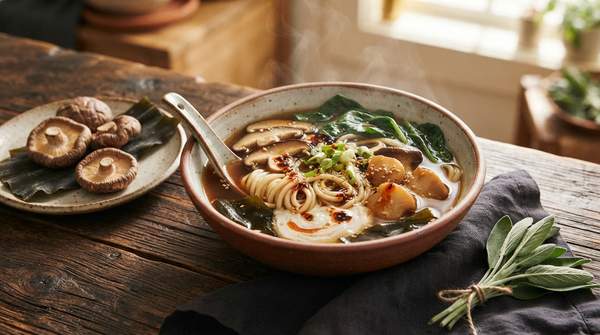
Here's the crucial part. Delish Knowledge illustrates it with a classic broth example: kombu alone in a broth elicits umami flavor, but combining kombu (glutamate) with dried mushrooms (guanylate) is what really makes for incredible umami. The combination creates much more umami than one compound alone — a multiplicative effect, not simple addition. For plant-based cooks, the practical translation is straightforward: one umami-rich ingredient is good; two from different chemical families are far better.