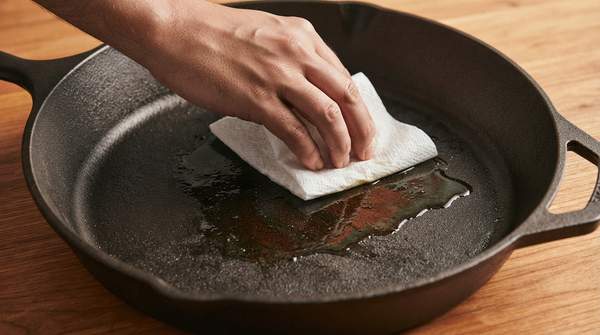
Cast iron seasoning is not a coating you buy or a film you wipe on once. It is a chemical transformation: a thin layer of cooking oil, baked at high heat, breaks down and recombines into a hard, cross-linked polymer chemically anchored to the pan's surface. Understanding that single process explains nearly every practical question a home cook has — which oil to choose, why the surface stays sticky, and why the finish improves with use rather than appearing perfect on day one.
The Science of Seasoning: Fat Polymerization Explained
Start with why bare cast iron misbehaves. Food sticks to pans because chemical bonds form between the food and the pan's surface, and protein-rich foods are especially prone to this, since their proteins form complexes with metal atoms in the cookware. That is why an unseasoned skillet grabs eggs and fish so aggressively. Cast iron itself is an alloy of iron, carbon, and silicon, and without protection it rusts rapidly — as Virginia Tech food scientist Sean O'Keefe explains, unlike stainless steel it lacks chromium, which would otherwise form a protective oxide layer on the surface.
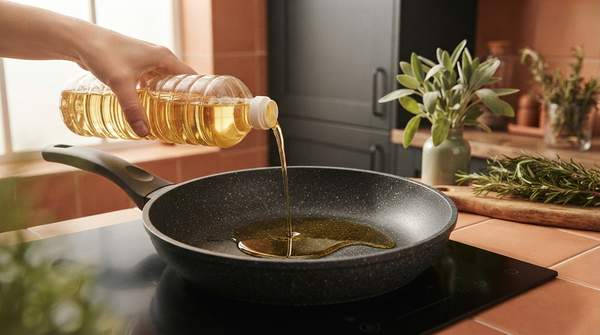
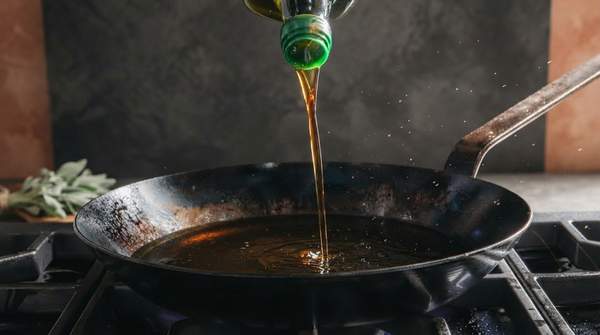
The seasoning process counters both problems at once. A thin layer of oil is applied and baked at high temperature, repeatedly. Under that heat, the oil does not merely sit on the metal — it polymerizes. Heat initiates thermoxidation: triglycerides, the main molecules of cooking oil, break down and generate reactive free radicals. Those radicals then cross-link, knitting individual fatty acid molecules into long-chain polymer networks. Research on frying oils shows polymerization begins from the very start of high-heat exposure, with oxidized and dimerized triglycerides becoming the dominant transformed compounds — the same chemistry that makes used frying oil thicken over time.
The result is a tough, hardened film that fills the microscopic pores of the iron and makes the surface smoother and water-repellent, so food no longer contacts bare metal directly. One caveat worth keeping: Chemical & Engineering News, whose chemistry educator Andy Brunning produced a widely shared graphic on cast iron cookware, later corrected its own attribution — while many authors believe the polymerized layer is what makes the pan non-stick, researchers have not definitively proved that mechanism. The practical evidence from millions of skillets is strong, but the definitive proof is still an open question in the literature.