The short answer: choose salt by crystal shape and density, not by the name on the box. A tablespoon of Morton kosher salt is much saltier than a tablespoon of Diamond Crystal, because Morton's thin, flat crystals pack more weight into the same spoon. That single fact explains most salt-measuring mishaps in home kitchens, and it is the key to picking the right salt for seasoning, brining, dissolving, and finishing.
The Impact of Crystal Structure and Density on Saltiness
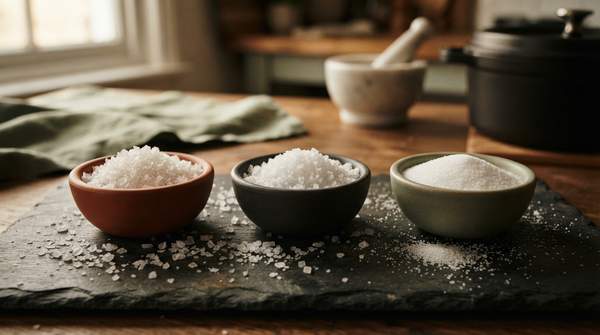
Every salt brand produces crystals that are distinct in size and structure, as Epicurious explains, because each employs different production methods. Those physical differences are not cosmetic trivia; they determine how much salt actually fits in a spoon and how it behaves in food. Larger crystals leave more air between them, so fewer of them fill a measuring spoon, and a given volume weighs less.
This is why salts are not interchangeable by volume. One teaspoon of Diamond Crystal is not the same measurement as one teaspoon of Morton kosher, even though both are labeled simply "kosher salt." By weight, different salts deliver equivalent salinity; by volume, they can differ dramatically. The practical consequence is that a recipe's saltiness depends on which salt the writer had in hand, and substituting blindly can over- or under-season a dish.
Kosher Salt: The Chef's Choice for Everyday Cooking
Kosher salt comes in coarse, flake, or fine grains from rock salt deposits. Because it lacks anti-caking agents, its taste is often described as more "pure" or "clean" than table salt, and Escoffier Online notes it boasts 97.5% salinity, letting you get more flavor with less application. Its large crystals dissolve easily, which makes it a workhorse for seasoning meats and poultry, and equally good for brining and curing. If you use it in baking, make sure it dissolves well.
Within kosher salt, the famous divide is Diamond Crystal versus Morton. The two are processed differently, producing different crystal shapes: Diamond's are hollow pyramids, while Morton's are thinner and flatter, meaning Morton weighs more per volume. So a tablespoon of Morton is much saltier than a tablespoon of Diamond. Diamond's larger flakes are easy to pinch and distribute, and its lower density means a tablespoon is gentler than other kosher salts, which is why many cooks prefer it for seasoning by hand.