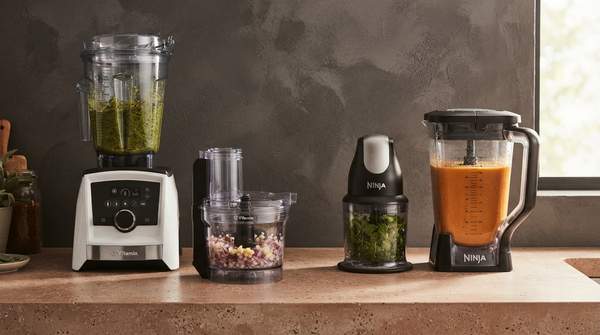
If you're setting up a plant-based kitchen, you don't need a drawer full of gadgets. You need two or three well-chosen tools, and the first big decision is simple: a high-speed blender if your cooking leans toward smoothies, sauces, dressings and creamy soups, or a food processor if you'd rather chop, slice, shred and make doughs and hummus. Everything else — an immersion blender, good knives — supports those two workhorses. Here's how the tools compare and how to spend your budget in the right order.
The Core Four: Essential Tools for Plant-Based Kitchens
Most plant-based cooks converge on the same short list. Chef Del Sroufe, who teaches whole-food plant-based cooking at the Center for Nutrition Studies, puts a blender at the top of his equipment guide: if you're cooking most of your own food, he writes, "you need a blender," one strong enough that the motor holds up to all the hummus you'll be making.
Alongside it sits the food processor. Wirecutter's reviewers describe it as the machine that "can speed up tedious cooking tasks (such as dicing nuts, ricing cauliflower, kneading dough, or chopping vegetables) and make prep-heavy recipes a bit less daunting." Marla Felcher, writing at Good News Veg, says her 14-cup food processor is the tool she uses "for everything — even things I'm not supposed to use it for," including a summer's worth of pesto.
The supporting cast: an immersion blender for quick blending jobs, and a quality chef's knife. Sroufe spends more of his money on knives than on anything else, on the logic that a good knife lasts for years with proper care.
High-Speed Blender vs. Food Processor: A Functional Showdown
These two appliances overlap less than you'd think. A blender's job is smooth and creamy. Maša Ofei, who writes the vegan kitchen guide at Heartful Table, calls her blender the other routinely used gadget in her house: "A blender is perfect if you want to make anything smooth and creamy," used for a wide range of tasks. Sroufe lists smoothies, sauces, salad dressings and soups as its core plant-based territory.
A food processor's job is texture and volume. Where a blender liquefies, a processor chops, slices, shreds and kneads — the tasks that turn raw vegetables into dinner in bulk. Wirecutter's team has kept the same 14-cup model as its top pick since 2013, calling it a "no-frills workhorse in a Goldilocks, just-right size."
The practical split: if your plant-based cooking means daily smoothies, nut-based sauces and blended soups, buy the blender first. If it means batch-prepping vegetables, cauliflower rice, nut fillings and doughs, buy the processor first. Most cooks eventually want both — but they don't need both on day one.