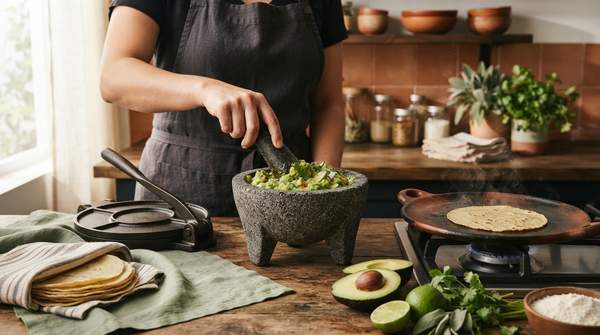
If your kitchen is small and your blender is already doing the heavy lifting, the honest answer is: probably one or two traditional tools, not the whole set. The tortilla press, molcajete, and comal each produce results tied to centuries of Mexican cooking, but they demand different amounts of space, effort, and care. The smart move is to build around functions—start with the dishes you actually want to cook, then decide whether the traditional tool or the modern version fits your counter, stove, and schedule.
Choosing Your Traditional Mexican Kitchen Tools: A Decision Framework
Victor Rubio, writing for the specialty grocer MexGrocer, frames the modern dilemma well: today's kitchens mix volcanic stone, clay, wood, iron, steel, and modern appliances on the same counter, and cooks can bring texture, ritual, and presentation back to the table "without giving up modern convenience." His advice is to build around functions rather than recreate a historical kitchen. Mely Martínez, the cook behind Mexico In My Kitchen, makes the same point from the home side: space, budget, and modern tools are all things to consider when buying gadgets, especially for younger cooks in small apartments.
That function-first logic is exactly how the framework below works. For each tool, compare the unique result against the modern alternative you likely already own, then weigh the investment in space and effort.
| Tool | Primary Cooking Task | Modern Alternative | Space & Effort Investment | Worth It If You Prioritize... |
|---|---|---|---|---|
| Tortilla press | Flattens masa for homemade corn tortillas, roughly 6.5 inches across | A rolling pin can shape masa, but a press delivers greater speed and consistency | Compact cast-iron tool; low effort per tortilla once you have the dough ready | Fresh tortillas on a regular basis without slowing down weeknight cooking |
| Molcajete | Grinding salsas, spices, and moles in volcanic stone | Blender or food processor, which chops rather than grinds | Manual grinding takes real effort; a heavy stone piece that lives on your counter | Texture and ritual in salsas, and a traditional serving vessel at the table |
| Comal | Flat griddle for cooking tortillas, toasting spices, and charring vegetables | A regular flat griddle or pan can do similar work | Flat, slim profile that stores easily; minimal effort, mostly heat management | Completing the tortilla-making process and charring for salsas |
Read the table as a trade-off analysis, not a shopping list. If you make tortillas from scratch even monthly, the press and comal together form one workflow—the press speeds up shaping, and the comal completes the process. If your love is salsa, the molcajete is the single tool that changes your results most, provided you accept the labor.
The Tortilla Press: Speed and Consistency for Fresh Tortillas
Here is a distinction that surprises many shoppers: the tortilla press is not an ancient artifact. As Rubio puts it, the tortilla belongs to a much older Mesoamerican food tradition than the manual presses found in home kitchens today, and a cast-iron or wood press "is better understood as a labor-saving tool that helps modern cooks participate in an old food tradition with greater speed and consistency."
That framing actually strengthens the case for buying one. You are not purchasing history; you are purchasing efficiency. A compact cast-iron press—MexGrocer's example is a seven-inch model that flattens masa into tortillas about 6.5 inches across—takes over the shaping work a rolling pin would otherwise do, but faster and with more uniform results. Martínez lists the press alongside the rolling pin in her survey of traditional utensils, which tells you the rolling pin route is genuinely possible; the press simply removes the inconsistency. For a small kitchen, its flat profile slides into a cabinet drawer, and the effort per use is minimal once your masa is mixed.
The Molcajete: Unlocking Authentic Flavors and Textures
The molcajete is where the trade-off gets sharp. This volcanic stone mortar and pestle grinds ingredients rather than chopping them, which is why cooks reach for it when making salsas, spice blends, and components of moles. A blender or food processor will get the job done faster, but the two actions are mechanically different, and the molcajete's grinding produces textures the blade method does not.
Rubio's broader point applies here: cooks today may not grind every ingredient by hand, but a molcajete can bring texture and ritual back to the table without forcing you to abandon modern convenience entirely. The honest cost is labor. Grinding a salsa by hand takes minutes of real work and a stone piece heavy enough that you will want a dedicated spot for it. If you make salsa weekly and care about the difference in the finished texture, that investment pays off. If salsa is an occasional side, your blender keeps its job.
The Comal: Versatile Griddle for Charring and Toasting
The comal is the quiet workhorse of the three. It is a flat griddle used for cooking tortillas, toasting spices, and charring vegetables—the charring step that gives many Mexican salsas their depth. Rubio describes it as the tool that completes the tortilla-making process after the press has done its part.
Its modern alternative is the humble flat griddle or pan you probably already own, and Martínez's catalog confirms the overlap: like every home, she notes, space, budget, and modern tools are things to consider before buying. What the comal offers is a design optimized for those specific traditional preparations rather than superior physics. That makes it the lowest-risk purchase of the set—flat, easy to store, no curing required—and the one where the authenticity argument is weakest if your current pan already chars vegetables well. Buy it if you are committing to the tortilla workflow; skip it if a good skillet already lives on your stove.
First Use and Care: Preserving Your Traditional Tools
Two non-obvious rules can save you from ruined tools or ruined dinners. First, a new molcajete generally needs curing before its first use, and the instructions vary by piece—Rubio's guidance is to follow the directions for the exact molcajete you own, and MexGrocer's own eight-inch molcajete page includes a curing guide and video. Do not assume one curing method fits every stone.
Second, and more critically: not every Mexican clay pot can go on the stove. Clayware can be cookware, serving ware, or purely decorative pottery. Use direct heat only when the specific product listing states the piece is intended for that use, and follow its heat and care instructions. A beautiful decorative cazuela on a burner is a cracked cazuela waiting to happen. Check the listing before you buy, not after.
Making Your Choice: Investing in Authentic Flavors
Home cooks should prioritize traditional Mexican tools like the molcajete, tortilla press, or comal if they seek unique textures and flavors unattainable with modern appliances, and are willing to invest in the associated effort and kitchen space. For most cooks, that means one targeted purchase driven by the dishes they make most often—press and comal for tortilla lovers, molcajete for salsa devotees—rather than a full set gathering dust. The measurable indicator that your choice was right: you will observe a noticeable difference in the texture and depth of flavor in dishes like salsas and tortillas made with the chosen traditional tools compared to those made with modern alternatives. If that difference shows up in your first few batches, the space was worth it.
Sources
- Traditional Mexican Kitchen Tools: Molcajete, Comal & More — MexGrocer.com
- Traditional Mexican cooking utensils — Mexico In My Kitchen