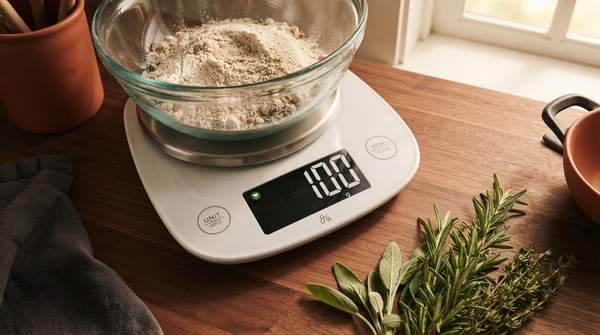
If you bake bread in big batches, you want a high-capacity scale with a long or adjustable auto-off timer — something like the MyWeigh KD-8000, which sourdough reviewers keep coming back to. If you mostly measure coffee, spices and yeast, you need the opposite: a tiny 0.1-gram pocket scale. And if your frustration is a giant mixing bowl hiding the readout, the fix isn't precision at all — it's a pull-out display. After reading through what Bon Appétit's test kitchen, America's Test Kitchen and two dedicated sourdough reviewers found, the honest answer is that no single scale wins every category, because the features trade against each other by design.
Key Features and Trade-offs in Kitchen Scales
The biggest trade-off in kitchen scales is capacity versus precision. Bon Appétit's testing highlighted the Greater Goods Digital Pocket Scale, which reads in 0.1-gram increments — fine enough for yeast or espresso doses — but maxes out at 1.65 pounds, which its testers called too small for most cooking or baking beyond coffee. At the other end sits the MyWeigh KD-8000, recommended by The Perfect Loaf for bread baking: it weighs up to 8000 grams (8kg), but it is precise only to 1 gram. In general, the scales that weigh the heaviest read the coarsest, and the most sensitive ones can't hold a mixing bowl. This is a pattern across the specifications of recommended models, though specific models can offer a balance.
The second trade-off is the auto-off timer, and it's the one bakers underestimate. A timer that shuts the scale down mid-recipe to save battery will zero out your progress while you're between additions. Bon Appétit flagged the Escali Primo's 4.5-minute auto shut-off as "among the longest of any model we tested, so you won't lose your measurements mid-bake." The Perfect Loaf notes the KD-8000 has an adjustable auto-off, plus the option of an AC-adapter version for continuous use. Rebekah Parr, who tested 20 scales for That Sourdough Gal, found one OXO model "never shuts off" — great for workflow, harder on batteries — while the Taylor she references "turns off very quickly." A short timer conserves battery life for general use; a long, adjustable or absent one is what you want for multi-step doughs.
Display readability is the third axis. America's Test Kitchen praises a scale whose screen "pulls out an extra four inches so that you can see it even when you're measuring larger bowls" — a feature its writer calls a genuine game changer. Bon Appétit's Escali takes a different route: an elevated platform offset from the base, so the display stays visible under a wide bowl. Scales without either solution tend to be more compact or cheaper, which is a fair trade if you mostly weigh into small containers.