Using the whole ingredient—every bone, stem, and leaf that's genuinely edible—is the simple idea behind two old kitchen philosophies: nose-to-tail for meat and root-to-stem (sometimes called leaf-to-root) for vegetables. As Kikkoman's food service guidance explains, these approaches were once less a trend and more a necessity, because meat was scarce and waste was not an option. Today, home cooks who adopt them cut household food waste, spend less at the grocery store, and often discover that the parts we throw away carry serious flavor. The catch: not every scrap belongs in the pot, so the first thing to learn is where the line sits.
Safety First: What Not to Eat
This is the boundary that matters most before you start experimenting: not all "secondary" plant parts are edible. Kikkoman's guidance is blunt on this point—some seeds, peels, or stems can be harmful or even toxic, and caution is essential precisely because these parts are not ones we normally eat.
The clearest examples are tomato leaves and rhubarb leaves. Both, according to Kiccoman's warning, contain substances that in larger quantities can cause nausea, digestive problems, or even poisoning. A handful of tomato leaves tossed into a stock pot is not the same as eating a salad of them, but the safer rule for a home cook is simple: when in doubt, always check whether a plant part is truly edible before cooking it—especially if it isn't a part of the plant you've ever seen sold as food.
There's a second, milder category worth knowing: parts that are technically edible but unpleasant or risky in quantity. Cooks who work with carrot tops note that the thicker stems are stringy, and the home cooking blog Eat Well Planner advises using only the finer leaves in raw sauces. The same source warns that when making stock, broccoli, cauliflower, cabbage, and Brussels sprout trimmings can turn the pot sulfurous if you add too much. None of that is dangerous—it's just the difference between a stock you want to sip and one you want to pour away, which rather defeats the purpose.
A final housekeeping rule from the same scrap-cooking guidance: only freeze clean trimmings. A scrap bag is for peels, ends, and bones from food you were going to use anyway—nothing moldy, slimy, or already spoiled. Extending the life of good food is the goal; rescuing food that has gone bad is not the same practice and not a safe one.
Quick-Reference Guide: Using Your Kitchen Scraps
Here is where the philosophy becomes dinner. The table below maps the ingredients most home cooks already have—chicken bones, organ meats, carrot tops, broccoli and cabbage-family trimmings—to specific, doable uses, so "waste less" turns into a concrete set of techniques rather than an abstract virtue.
| Ingredient Part | Culinary Use | Benefit |
|---|---|---|
| Chicken carcass and bones | After a roast or rotisserie chicken, freeze the carcass; make stock once you've saved two or three. | Deep golden-brown, flavorful stock from something you already paid for. |
| Organ meats (heart, liver, kidney) | Braise, grill, or use in traditional dishes, as generations of cooks did when nothing went to waste. | Often packed with flavor and nutrients; cheap cuts become delicacies. |
| Carrot tops (fine leaves) | Blend into pesto, chimichurri, green sauces, yogurt or tahini dressings, or simmer into broth; blanch the delicate leaves briefly and dress with soy sauce, sugar, and sesame oil as a side dish. | A free herb substitute; Eat Well Planner suggests a half-and-half ratio with other greens to keep bitterness in check. |
| Carrot top stems | Add the thin stems to your stock bag; discard the thick, stringy ones. | Flavor without the fibrous texture. |
| Cabbage-family trimmings (broccoli, cauliflower, Brussels sprouts) | Use sparingly in stock—go easy, or the stock turns sulfurous. | Knowledge of the limit keeps your stock drinkable. |
| Beet peels | Keep separate or use knowing they will turn stock pink. | Avoids an accidental bright-pink broth. |
A few of these deserve a closer look, because the details are what make them work. The chimichurri idea from Eat Well Planner is a genuinely good one: chop carrot tops fine with garlic, red wine vinegar, oregano, red pepper flakes, and olive oil, using the tops in place of some of the parsley, then spoon the sauce over roasted carrots for what the site aptly calls a root-to-leaf moment. A small handful blended into a yogurt or tahini dressing adds color and an herby edge.
Carrot-top broth is even simpler. Kristina Todini, a registered dietitian writing at Fork in the Road, uses carrot tops and other scraps in broths to bring flavor to the dish, removing them before serving; her recipe keeps the broth plant-based and, in her words, reduces overall household food waste. Store it in the refrigerator if you'll use it within four days, or freeze it for two to three months.
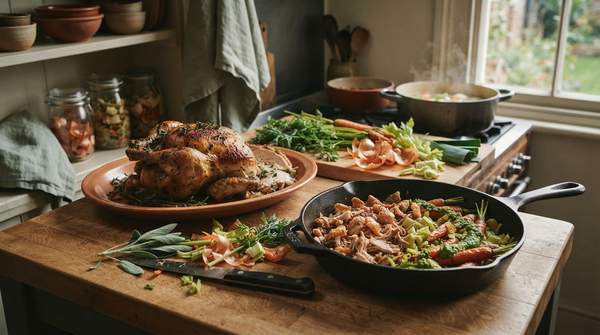
On the animal side, the stock pot is the easiest entry point. Freeze the carcass after a roast chicken and save it until you have two or three, then simmer them. One caution from Eat Well Planner: use a few bones, not a whole bag's worth, since too many can turn the stock bitter—and cool homemade stock quickly once it's done. Organ meats are the bolder move. Kikkoman's account of kitchen history notes that heart, liver, and kidney were once regular features on the plate—blood even went into black pudding—and with the right handling, braised or grilled, less common cuts can still be transformed into sought-after dishes.
The practice is also easier than it sounds. Kikkoman's own assessment is that nose-to-tail and leaf-to-root cooking might sound labour-intensive, but they're often easier to put into practice than you think. A scrap bag in the freezer and one stock pot cover most of it; the pesto and chimichurri ideas take minutes.