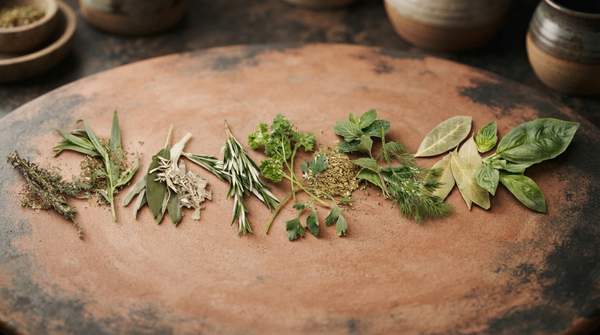
The secret to seasoning with herbs isn't memorizing a list—it's knowing two things: what kind of herb you're holding and how long it will spend in the heat. Culinary writers consistently divide common herbs into two personalities. Delicate, leafy herbs like basil, parsley, cilantro, dill, mint, and tarragon shine when used fresh and added late. Hearty, sometimes woody herbs like rosemary, thyme, sage, and oregano can go in early, and their dried forms often work as well as—or better than—fresh. Match the herb's personality to the cooking method, and the fresh-versus-dried question answers itself.
Understanding Herb Personalities: Delicate vs. Hearty
Food writer Jill Silverman Hough offers a useful sorting test: when cooking with fresh herbs, "think about whether they're delicate and leafy, like the aforementioned parsley, mint, cilantro, and tarragon, or hearty and possibly woody, like rosemary, thyme, sage, and oregano." That single distinction drives almost every practical decision about form and timing.
Delicate herbs are the perfume of a dish—bright, aromatic, and easily lost. They belong in raw dishes like salads, salsas, and guacamole, as garnish for soups and pastas, and as a finishing touch on roasted meats or vegetables. Their flavors fade with prolonged heat, which is why timing matters so much for them. Hearty herbs are built differently: their robust flavors withstand and even benefit from longer cooking, which is why they anchor long-simmered sauces, roasts, and braises.
The distinction also explains why substitution isn't automatic. As Matthew Card writes at Milk Street, dried herbs "aren't a simple swap for fresh. They can be milder or stronger than their fresh form—and sometimes unpleasantly tough or twiggy." Knowing which side of the line your herb falls on tells you whether drying helps or hurts.
Herb Selection and Timing Decision Matrix
Use this matrix to move from classification to action: find your herb type, find your cooking application, and read off the form and timing. The logic is that delicate herbs lose their aromatic qualities under heat, while hearty herbs and all dried herbs need time in the cooking liquid to hydrate and infuse—Hough compares dried herbs to tea leaves that need time to release flavor into hot water.
| Herb Type | Examples | Recommended Form | Best Applications | When to Add |
|---|---|---|---|---|
| Delicate herbs | Basil, parsley, cilantro, dill, mint, tarragon | Fresh is generally preferred, to preserve their aromatic qualities | Salads, salsas, guacamole, pesto, garnishing soups and pastas, finishing roasted dishes | At the very end of cooking, or in raw dishes; their flavors are easily lost with prolonged heat |
| Hearty herbs | Rosemary, thyme, sage, oregano | Both fresh and dried work; dried often preferred for concentrated, earthy flavor | Long-simmered sauces and stews, roasted meats and vegetables, dry rubs | Early in cooking so flavors infuse; sage or oregano can also go in as late as the last five to ten minutes |
| Dried oregano | — | Dried often preferred over fresh for a more potent, earthy character | Mediterranean and Mexican cuisines | Early in cooking, so it can hydrate and infuse |
| Dried mint | — | Essential in certain cuisines for its surprisingly potent flavor | Levantine and Greek cooking: soups, stews, beans, dips, dressings | During cooking; its brittle texture crumbles and blends into the dish |
Two worked examples show the matrix in action. For a long-simmering stew, choose a dried hearty herb like rosemary and add it early so it has time to rehydrate and infuse. For a fresh salsa, choose fresh delicate cilantro and stir it in just before serving so its bright, clean flavor survives.