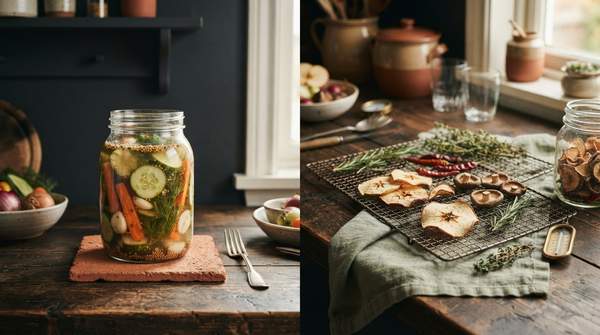
Every safe home preservation method works by throwing a scientific barrier—a "hurdle"—in front of the microorganisms that cause spoilage and foodborne illness. Vinegar pickling stops microbes by plunging food into acid, driving its pH to 4.6 or below. Drying stops them a completely different way, by pulling out so much water that bacteria and molds simply cannot get the moisture they need to grow. Understanding which hurdle each method uses is the key to using each one safely.
The Science of Food Preservation: Understanding the Hurdles
Food scientists describe preservation as a set of hurdles, a framework commonly credited to researcher L. Leistner's 1995 work. The hurdles include high temperature, low temperature, reduced water activity, increased acidity, reduced redox potential, and the addition of preservatives or competitive microbes. No single method is magic; each one selects one or more of these barriers and pushes it far enough that hazardous organisms can't multiply.
For the home cook, two hurdles matter most in everyday preservation: acidity, measured as pH, and water activity, written as aw. Food science distinguishes them carefully. pH measures how acid or basic a food is; water activity measures how much of the food's water is actually available to microbes. These are separate levers. A pickle can be swimming in liquid and still be safe, because its hurdle is chemical. A dried vegetable chip contains almost no available water at all, and that's what protects it. That distinction explains why the safety procedures for the two methods look so different.
Pickling: The Acidity Hurdle (pH Control)
Pickling is, as Illinois Extension describes it, an ancient form of preservation that works either through anaerobic fermentation in brine or through immersion in vinegar. This article covers the second kind: quick pickles made with vinegar, where the acid comes from outside rather than from fermenting microbes.
The National Center for Home Food Preservation explains that pH is a measure of acidity, and that the lower its value, the more acid the food. Acidity can be increased by adding lemon juice, citric acid, or vinegar. The dividing line is pH 4.6: acid foods sit at 4.6 or lower and include fruits, pickles, sauerkraut, jams, jellies, marmalades, and fruit butters. Low-acid foods—red meats, seafood, poultry, milk, and all fresh vegetables except most tomatoes—have pH values higher than 4.6. Most mixtures of low-acid and acid foods are also above 4.6 unless the recipe includes enough added acid to bring them down.
That number matters because of one organism in particular. Clemson University's Home & Garden Information Center identifies Clostridium botulinum as the main reason low-acid foods require pressure canning: its spores survive boiling water and can grow in a sealed jar of low-acid food. A vinegar pickle escapes that fate only if enough acid penetrates the whole product—not just the brine—to keep every bite below 4.6.