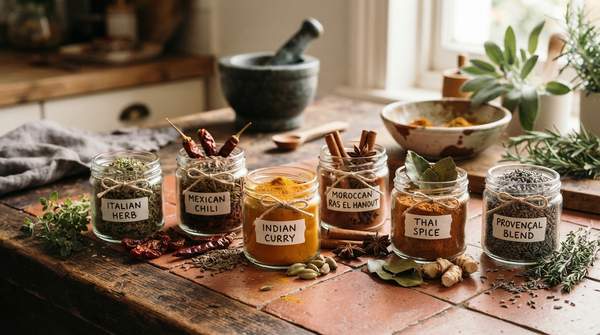
If you want to travel the world from your kitchen, you only need a mixing bowl and about ten minutes. Food writer Alida Ryder's set of six homemade blends—an Everyday mix, Italian, Mexican, South African, Mediterranean, and Indian—covers a remarkable swath of global cooking with nothing more exotic than smoked paprika and ground cardamom. I've built them into a comparison guide below so you can see, at a glance, which blend belongs on tonight's plate.
The principle behind all of this is simple, and Pacific Spice Company captures it well: regional cuisines are defined by the herbs and spices that grow locally and were historically accessible there. Cook Smarts' Jackie Sun puts the practical version of the same idea plainly—if you're making a Mexican dish and it tastes bland, reach for the spices native to that cuisine, like cumin, coriander, oregano, garlic powder, and chili powder. Blending those spices in advance means the decision is already made when you start cooking.
Mastering Global Flavors: Your DIY Spice Blend Guide
Homemade blends earn their place in your pantry for two reasons: control and freshness. When you mix your own, you decide the salt level and the heat, which store-bought mixes rarely let you do. And unlike a jar that has sat on a warehouse shelf, a blend you mix tonight contains only the spices you can vouch for. As the Nature's Path spice guide notes, spices are better ground fresh when possible, because the flavor of freshly ground spices is far superior to grocery-store ground ones—and some preparations even call for dry toasting to coax out the flavors.
What makes a blend versatile rather than a one-trick jar is balance. Twisted Pepper Co.'s editorial team describes how well-constructed global blends work across applications: they combine "warm spices, bright elements, savory depth, and often a touch of heat, creating complexity that feels complete on its own." That's the design logic behind all six recipes here—each one is built on that warm-bright-savory skeleton, just tuned to a different cuisine.
The payoff, as Oldways' guide to Mediterranean spices observes, is that herbs and spices can make a dish Greek or Turkish or Italian depending on which ones you use, and they can reduce the need for a lot of added salt at the same time. Six small jars, in other words, are a lever on both flavor and salt in everything you cook.