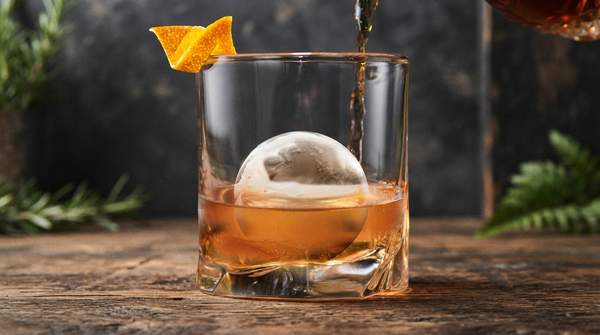
The best ice for your cocktail depends on one trade-off: how fast you want the drink chilled versus how much water you can tolerate in the glass. A single large sphere or king cube melts slowly, keeping a spirit-forward drink like an Old Fashioned cold without watering it down, while crushed or nugget ice chills almost instantly but can significantly change a drink's flavor within minutes. Once you understand that surface area drives melting, picking the right ice becomes a deliberate choice rather than a freezer-tray default.
The Science of Ice: Chilling, Dilution, and Surface Area
Ice does two jobs in a glass, and they work against each other. It chills the liquid, and as it does, it adds water. A drink needs to be cold, but too much meltwater ruins the balance of flavors, so the shape of the ice determines how quickly that tension resolves.
Surface area is the main factor. Smaller pieces expose far more total surface to the warmer liquid than a single large block of the same volume, which means faster heat transfer: the drink gets cold very quickly, but the ice also turns back into water just as fast. Density is the second factor. Clear, dense ice lasts longer than cloudy, air-filled tray ice, because air pockets let warmer liquid penetrate the cube and break it apart from the inside.
Common Ice Types and Their Characteristics
Each common ice shape occupies a distinct point on the speed-versus-dilution spectrum. Spheres are perfectly round and melt very slowly, which is why they're used to minimize dilution of premium spirits and enhance presentation. Large king cubes share that slow melt rate, delivering maximum cooling with minimal dilution. Standard cubes are the versatile middle ground, used in most cocktails.
Collins spears are long, thick rectangular blocks built specifically for tall, narrow glasses. Nugget ice sits at the opposite extreme: soft, porous, and chewable, it cools beverages quickly and readily absorbs the flavors of the drink, but it melts very fast. Crushed ice behaves similarly, chilling rapidly and turning a drink toward a refreshing slush.
Matching Ice to Your Cocktail Style
The practical question is what you want the drink to become. For straight spirits and spirit-forward cocktails—an Old Fashioned, a neat whiskey—large spheres are the standard choice for slow dilution, preserving the flavor of the spirit over the long life of the drink. A standard 2.5-inch sphere can last one to two hours in a glass, depending on ambient and liquid temperature.
At the other end, crushed ice belongs in syrup-heavy drinks: tiki drinks, juleps, and swizzles, where fast chilling and a slushy texture are the point, and the recipe expects dilution as part of its character. Nugget ice suits some highball drinks where its soft texture is part of the appeal. Standard cubes handle everything in between—mixed drinks, soft drinks, frozen cocktails.
The Perfect Fit: Ice and Glassware Pairings
Ice shape and glassware are designed for each other. A sphere won't fit in a narrow glass, and nugget ice looks messy in a shallow coupe. In a rocks glass, a large sphere or king cube fits the wide base and keeps spirits cold without watering them down. In a highball or Collins glass, standard square cubes stack to the rim, keeping the entire tall drink cold and carbonated, while a Collins spear—shaped for Tom Collins, gin and tonics, and Mojitos—melts slowly and chills the drink from top to bottom.
The coupe and Martini glass are the exception that proves the rule: no ice at all. Those drinks are chilled during shaking or stirring, and ice in the glass would ruin the presentation.
The Clear Ice Advantage for Home Bartenders
Clarity matters as much as shape. Clear, dense ice lasts longer than cloudy tray ice because it lacks the internal air pockets that let warm liquid penetrate and break the cube apart from within. The qualitative benefit is consistently reported—slower melt, less dilution, and a more visually appealing drink—though the sources here describe the difference qualitatively rather than with a measured melt-rate figure. For a home bartender, clear ice is worth the effort precisely where dilution control matters most: spirit-forward drinks sipped slowly.
Choosing Your Ice: A Cocktail Decision Framework
The table below maps each ice type's physical characteristics to its ideal cocktail and glassware, so you can match the ice to the drink you're actually making.
| Ice Type | Shape/Size | Relative Surface Area | Melt Rate (Dilution) | Best For | Glassware |
|---|---|---|---|---|---|
| Sphere | Perfectly round, ~2.5 in. | Low | Very slow; can last 1–2 hours | Neat spirits, Old Fashioned, spirit-forward drinks | Rocks glass |
| Large cube (king cube) | Large, solid, square or rectangular | Low | Slow; maximum cooling, minimal dilution | Spirit-forward cocktails | Rocks glass |
| Standard cubes | Medium square cubes | Moderate | Moderate | Most mixed drinks, soft drinks, frozen cocktails | Highball/Collins glass |
| Collins spear | Long, thick rectangular block | Low relative to volume | Slow; chills top to bottom | Tom Collins, gin and tonic, Mojito | Highball/Collins glass |
| Crushed | Small fragments | High | Fast; changes flavor within minutes | Tiki drinks, juleps, swizzles, syrup-heavy drinks | Julep cup, tiki mug |
| Nugget | Soft, porous, chewable pellets | High | Very fast; absorbs drink flavors | Some highball drinks where texture is desired | Highball glass |
Read the table as a decision path: start with the cocktail category, then confirm the glassware fits. A Mint Julep calls for crushed ice and its rapid dilution; a Tom Collins calls for a spear or stacked cubes; an Old Fashioned calls for a sphere or king cube. Note that these pairings reflect common cocktail categories—specific recipes may have unique requirements, and this guide covers water ice only, not dry ice or other specialty cooling agents.
Elevate Your Home Bar: The Right Ice for Every Drink
Home bartenders should consciously select ice based on its shape, size, and clarity to control dilution, temperature, and presentation, rather than defaulting to a single ice type for every drink. The payoff is measurable at your next mixing session: the next cocktail prepared at home demonstrates the desired balance of flavor and chill, with minimal unwanted dilution, and an appealing visual presentation. If your Old Fashioned still tastes of whiskey twenty minutes in, or your julep has that proper frosty slush, the ice did its job.
Sources
- What Is the Best Shape of Ice for Cocktails? — Euhomy
- What Bar Operators Should Know About Ice, Choosing the Right Ice for Cocktails — Bar & Restaurant
- Ice Shapes: A Guide for Foodservice Professionals — The Official Wasserstrom Blog