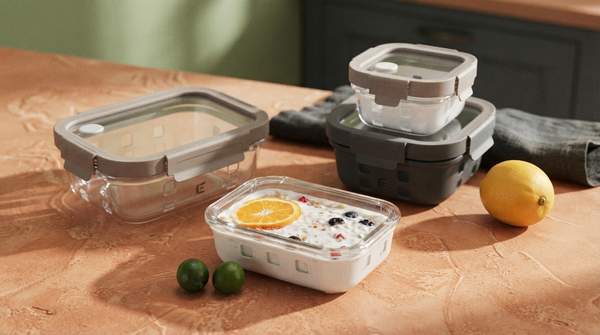
There is no single "best" food storage container material—there is only the best material for what you are storing and how you plan to use it. Glass wins for acidic, fatty, and cooked foods you intend to reheat, because it is almost chemically inert and tolerates microwave and oven temperatures. Stainless steel wins for portability and durability, making it the natural choice for packed lunches and raw proteins. Silicone fills the flexible middle ground: lightweight, pliable, and well suited to snacks, small meals, and freezing. The reasoning behind these pairings comes down to three measurable properties—chemical reactivity, durability, and temperature resistance.
Understanding Your Options: Glass, Stainless Steel, and Silicone
These three materials have become the standard recommendations for home cooks looking to move away from plastic. Consumer Reports' lab testing of food storage containers deliberately excluded plastic models, citing concerns about the effects of microplastics on the body and the environment, and instead evaluated glass, stainless steel, and silicone. Across the 28 containers its testers examined, the standout products shared two qualities: they sealed tightly and did not leak when testers sloshed water inside them.
That leak-proof performance matters as much as the material itself. A container that keeps air out keeps food fresher longer, and a container that does not leak survives the commute to work or school. So the real decision is a two-part question: which material suits your food, and which design suits your routine.
Chemical Reactivity and Food Safety: Why Material Matters
The scientific case for these three materials rests on how little of them ends up in your food. According to the Food Packaging Forum's migration framework, plastics and paper-board release many different chemicals, often in high amounts, whereas glass and stainless steel are "almost inert and very few chemicals transfer at low levels." A review published in the journal Foods explains the mechanism: substances in packaging materials—additives, monomers, colorants, and manufacturing residues—naturally migrate from areas of higher concentration into food upon direct contact.
Crucially, that migration is not uniform across foods. The Food Packaging Forum's framework scores migration risk by food characteristics, and fatty, acidic, long-stored, and high-contact foods like cheese, salad, and fresh produce rank higher than dry goods like pastries. In practical terms, a tomato-based sauce stored for days is a very different chemical environment from flour in the pantry—and that difference should drive your container choice.
Glass Containers: Versatility for Cooking and Storage
Glass is the workhorse of leftover storage. Guidance from The Paleo Diet identifies glass as best for storing fats, liquids, cooked proteins, vegetables, fruits, and leftovers, precisely because of its non-reactive nature—it will not absorb odors or flavors, and it will not interact with the acid in tomato sauce or the fat in braised meat. Consumer Reports' testing found glass models that are supremely durable while keeping food fresh and flavorful.
The practical advantage is the jump from fridge to heat. Glass containers designed as microwave- and oven-safe can move directly from cold storage to reheating without decanting food into another dish—fewer dishes, less waste. The trade-off is weight and fragility: glass is the heaviest of the three options, and a dropped container can shatter, which makes it a less confident choice for a backpack or a child's lunch bag.
Stainless Steel Containers: Durable and Portable
Stainless steel shares glass's key safety property—near-total chemical inertness—while solving its main weakness. It is durable and lightweight, which is why The Paleo Diet recommends it for raw proteins, vegetables, nuts, seeds, and portable meals. Its durability makes it the clear choice for transport: it survives being dropped, packed, and rattled around in a bag.
Its limitation is heat. Stainless steel is not suitable for microwave use, so reheating lunch means transferring food to a plate or bowl first. For meal preppers who cook, portion, and refrigerate but reheat at home in a pan or oven, that is a minor inconvenience; for office workers who rely on the microwave, it is a genuine drawback. Stainless steel also blocks any oven-based reheating unless the manufacturer explicitly permits it.
Silicone Containers: Flexible and Lightweight Solutions
Silicone is the newest of the three and occupies a distinct niche. The Paleo Diet's guidance describes silicone as handy for snacks and small meals on the go, noting that it is pliable, durable, and non-toxic. Its flexibility is not just a comfort feature—it is what makes silicone the standout choice for the freezer, because frozen contents pop out of a flexible container far more easily than from rigid glass or steel.
Bon Appétit's commerce writer Wilder Davies, who has tested kitchen equipment since 2019, counts himself among the meal-preppers who have "endured more than one mid-transit lunch leak"—a failure mode silicone's soft, sealable designs are built to avoid. Consumer Reports separately tests silicone bags among its storage recommendations, reflecting how established the material has become for home use.
Decision Framework: Matching Container Material to Your Food and Use
The table below compares the three materials across the properties that drive freshness and safety, then translates those properties into recommendations for common scenarios.
| Material | Key Properties | Best For | Use Case Considerations | Chemical Reactivity/Safety |
|---|---|---|---|---|
| Glass | Non-reactive, durable, generally safe for microwave, oven, and dishwasher (in containers designed for such use) | Fats, liquids, cooked proteins, vegetables, fruits, leftovers, and reheating meal prep | Fridge-to-microwave reheating without decanting; heavy and can shatter if dropped, so weaker for transport | Almost inert; very few chemicals transfer at low levels, making it safe for acidic and fatty foods |
| Stainless steel | Durable, lightweight, non-reactive; does not absorb odors or flavors | Raw proteins, vegetables, nuts, seeds, and portable meals | Best for lunch bags and transport; not suitable for microwave use, so food must be transferred for reheating | Almost inert, with minimal chemical transfer to food |
| Silicone | Pliable, durable, non-toxic, can provide an airtight seal | Snacks, small meals on the go, and freezing liquids | Flexibility aids portioning and removal of frozen contents; lightweight for bags and drawers | Described as non-toxic in the context of food contact |
Reading the table as a decision path: start with the food. Acidic or fatty leftovers point to glass, since its inertness matters most where migration risk is highest. Dry goods and pantry items are the least chemically demanding—any of the three works, so choose on convenience. Then adjust for the use: if the container travels, shift toward stainless steel or silicone; if the food goes from fridge to microwave, glass is the only one of the three that does it directly; if the food goes into the freezer as a liquid, silicone's flexibility makes portion release easiest.
Making the Best Choice for Your Kitchen
Home cooks should select food storage containers by considering the specific food type—acidic, fatty, or dry—and the intended use, whether reheating, freezing, or portability, to align with the chemical reactivity, durability, and temperature resistance of glass, stainless steel, or silicone. In practice, most kitchens benefit from a mix: glass for leftovers and reheating, stainless steel for lunchboxes and raw ingredients, silicone for the freezer and snacks.
The results are observable. You will know your system is working when you see reduced food waste, notice no absorbed odors or flavors in your containers, and can reheat stored food with confidence in its safety. Check your containers' care symbols—a snowflake marking means freezer-safe, and water droplets mean dishwasher-safe—before relying on any container for a specific task.
Sources
- 9 Best Food Storage Containers of 2026, Lab-Tested and Reviewed - Consumer Reports
- Foodpackagingforum
- MDPI
- Food Storage 101: Safe Food Storage Containers and Best Practices — The Paleo Diet®
- I Dropped, Shook, Stained (and Sometimes Shattered) Food Storage Containers To Find the 3 Most Durable Picks — Bon Appétit